

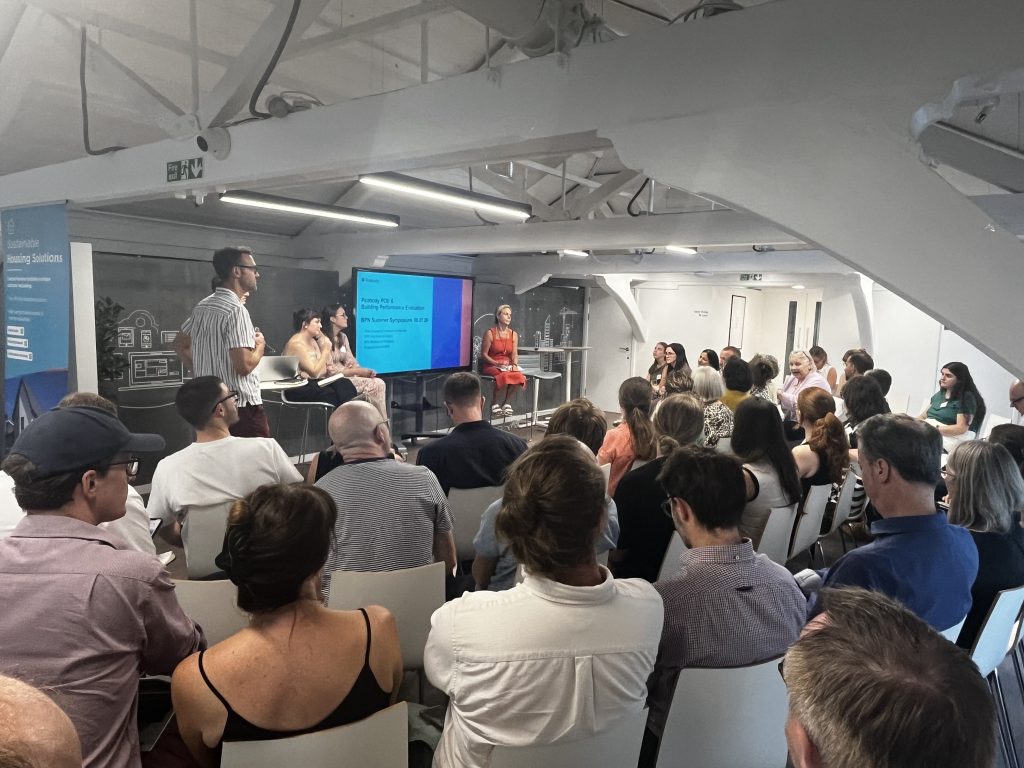
On 8 July 2026, the Good Homes Alliance (GHA) via our Building Performance Network (BPN) welcomed over 45 housing professionals, clients, designers, researchers and building performance specialists to PRP Architects’ London office for our Summer Symposium: “Demystifying Residential POE.” The event explored how Post Occupancy Evaluation (POE) can help the housing sector better understand how homes perform once people move in, and how those lessons can be used to improve future projects.
Hosted by PRP Architects and sponsored by Saint-Gobain in association with their QUB solution, the afternoon combined case studies, practical lessons learned, emerging measurement technologies and a lively discussion on resident experience.


Why POE Matters
A recurring theme throughout the symposium was that POE is not an end in itself. It is a tool for learning, accountability and continuous improvement. Whether through resident feedback, technical monitoring or building performance analysis, the ultimate goal is to create homes that are healthier, more comfortable, more efficient and better aligned with the needs of occupants.
Learning from Real Projects
The first session, Case Studies and Lessons Learned, was chaired by Dr Tom Dollard, Chair, GHA, and focused on practical case studies and lessons learned from organisations already embedding POE into their work.
Presentations included Chobham Manor, Olympic Park from Naomi Crawford, Director, PRP, and Gwenaël Jerrett, Architect & Design Principal at the London Legacy Development Corporation, which explored the first completed Olympic legacy neighbourhood as a live example of how design ambitions translate into resident experience and measured performance over time. The case study set out how the development’s family-focused masterplan, mix of housing typologies, green spaces and sustainability objectives were tested through POE, generating lessons on comfort, overheating risk, energy use, public realm and long-term neighbourhood quality.
One of the strongest messages came from Islington Council’s presentation: the starting point and end point of POE should always be residents. A compelling resident story demonstrated how lived experience can reveal issues that are not obvious during design or construction, reinforcing the importance of understanding how people actually experience their homes after occupation.
Jane Briginshaw shared its journey towards bringing together multiple strands of information, from technical performance and resident feedback to maintenance insights and compliance findings, to support better decision-making and governance. The focus is increasingly on turning data into action and ensuring lessons learned influence future projects.
Scaling Building Performance Evaluation
Lefkos Kyriacou, Senior Technical Manager, Development at Peabody provided an overview of how it is embedding POE and Building Performance Evaluation across its housing portfolio. Their approach combines resident surveys, targeted deep-dive studies and technical performance monitoring to answer a series of key questions:
- What should we do differently next time?
- Is the building working as designed?
- How does it feel to live there?
- How energy efficient, healthy and comfortable is the home?
The presentation demonstrated how performance evaluation can generate tangible outcomes, from identifying installation issues and maintenance problems to improving handover procedures, resident guidance and design standards.
A notable takeaway was the emphasis on creating feedback loops that ensure findings are carried forward into future projects rather than remaining isolated reports.
Launching the Good Homes Charter Mark
The symposium also included a soft launch of the new Good Homes Charter Mark. The initiative aims to recognise housing projects that go beyond minimum standards and deliver high-quality, future-ready homes.
The Charter Mark is awarded to both new build and retrofit projects that demonstrate excellence across five key delivery outcomes – these are underpinned by a sixth, core requirement: post-occupancy evaluation (POE), ensuring homes perform in use as intended.
Key delivery outcomes:
- Operational Energy
- Embodied Carbon
- Healthy Homes
- Climate Resilience
- Nature
We are introducing the GHA Charter Mark in response to a gap in current standards and regulations, which often focus too narrowly on energy efficiency and fail to distinguish truly exemplary homes. The Charter Mark sets out a more holistic definition of best practice, helping industry and the public recognise homes that deliver outstanding performance, quality and long-term value.
Measuring Performance: The Quantitative Perspective
The second half of the symposium shifted focus towards building performance measurement and the growing role of data in understanding how homes operate in practice.
The Quantitative Data – Measuring Performance session was chaired by Dave Glew, Professor of Sustainable Buildings at Leeds Beckett University. Presentations explored how faster, more practical measurement methods can help the sector move from assumptions about performance to evidence-based decision-making.
Tom Cox, Construction Solutions Director, Saint-Gobain, introduced Saint-Gobain’s QUB approach as a rapid pre-occupation test designed to measure the thermal performance of an unoccupied home. Rather than relying solely on modelled design-stage performance, QUB provides a way to test the building as constructed, generating a heat transfer coefficient that can be compared with the assumptions made in SAP or other design calculations.
The method was presented as particularly relevant to housebuilders and clients seeking quicker quality assurance before handover. A typical QUB test is carried out overnight, between sunset and sunrise, and follows a controlled sequence: a heating phase, a natural cooling phase and a calculation phase. By measuring how the building responds, the test can provide an indication of whole-building fabric heat loss in a much shorter timeframe than traditional co-heating approaches.
Richard Jack, Technical Director at Build Test Solutions built on this theme by setting out the wider role of measurement-led diagnostics. His contribution underlined that individual test results are most useful when they can be interpreted alongside other performance indicators, such as airtightness, U-values, energy use, environmental monitoring and resident feedback. This joined-up approach helps move BPE from a one-off exercise towards a practical diagnostic process that can identify not only whether a building is underperforming, but why.
For the audience, this was an important distinction. The value of quantitative POE is not simply the collection of more data; it is the ability to turn measurements into decisions about design, construction quality, commissioning, handover, retrofit strategy and resident support. In that sense, rapid testing and digital diagnostics can help make building performance evaluation more scalable, repeatable and actionable across housing portfolios.
Innovation Lead on heat and buildings at Innovate UK Laura Morgan-Forster placed these developments within the wider innovation landscape. Innovate UK’s work on heat and buildings has focused on reducing the cost and time needed to assess fabric performance, supporting data-led approaches to retrofit and helping organisations test scalable solutions for decarbonising heat. Her contribution highlighted the importance of creating market confidence in measured performance, particularly as the sector prepares for more ambitious net zero and building quality expectations.
Bringing Residents Back into the Conversation
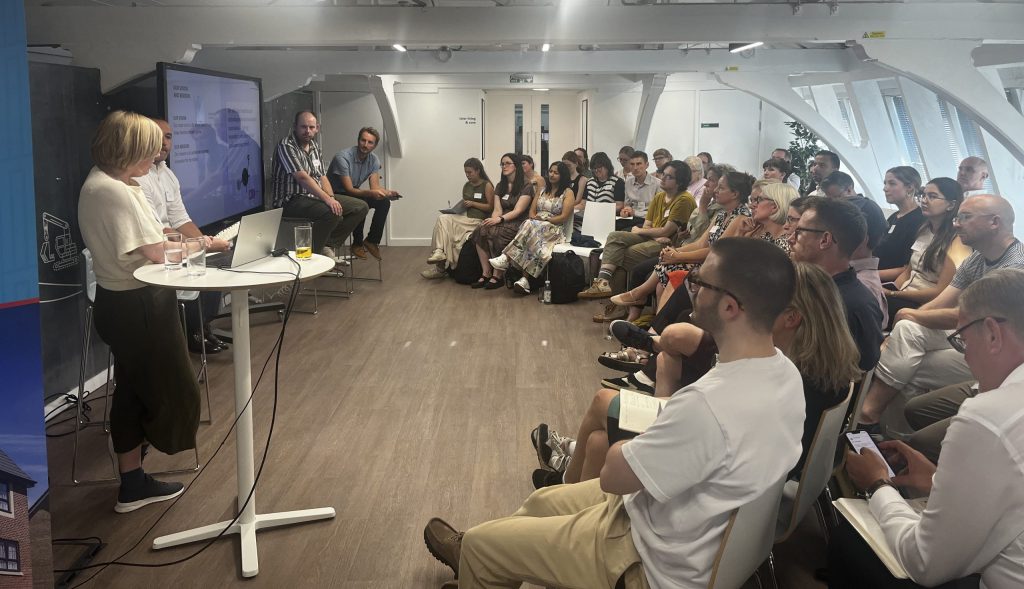
The final session, Qualitative Measures – Residents’ Experiences, returned to the human side of performance through a “fishbowl” format panel. Chaired by Laura Broderick, Programme Director, GHA, the discussion brought together voices from housing, research, placemaking and design, including Dr Elanor Warwick, Clarion Housing, and Patrick Devlin, Pollard Thomas Edwards, and John Stiles from Brent Council with input from audience members, namely Clare from Levitt Murray Leviitt Bernstein sharing residents views from a recent project walkaround in Haringey.
The session reinforced a message that had run throughout the day: quantitative metrics are essential, but they are only part of the story. Understanding how people feel about their homes, neighbourhoods and day-to-day living experience remains fundamental to evaluating success. As Patrick said, “Building performance data and residents’ experiences are two sides of the same coin.”
Looking Ahead
The 2026 Summer Symposium demonstrated how far the industry has progressed in developing practical approaches to residential POE and BPE. More importantly, it showed a growing consensus that better housing outcomes will require a combination of measured building performance, meaningful resident engagement and robust mechanisms for learning from completed projects.
As interest continues to grow, initiatives such as the Good Homes Charter Mark, expanding POE programmes and new performance measurement tools are helping move the conversation from theory to practice, making complex building performance issues simpler, clearer and more actionable for the sector. We are feeling optimistic!
Thank you again to PRP Architects for hosting the event, and to Saint-Gobain for sponsoring the symposium in association with their QUB solution.