Kate de Selincourt, Health and Wellbeing Associate, Passivhaus Trust, has written a thoughtful write-up of the Good Homes Alliance and South East Consortium 2026 conference “Beyond Net Zero”. The conference, held on 28th January 2026, was attended by 200 cross-sector delegates with presentations, interactive Q&A, and panel discussions. Kate’s write up captures both the urgency of the challenges facing UK housing and the strong sense of determination across the sector to address them. Her report highlights the key themes and insights from a day of frank discussion among practitioners, policymakers and industry leaders.

___
The event jointly hosted by the Good Homes Alliance and the SouthEast Consortium proved an inspiring and heartening day. While no one disputed the immense problems and challenges standing in the way of providing UK households with the good homes they need, there was no shortage of ideas for fixing things – and enthusiasm for taking them up.
The main messages of the day for me, might be summarised as:
We need feedback – so we actually know what we are doing! From the technical measurements of air permeability, energy use, humidity and the like, to the wider ‘quality of place analysis that needs surveys (and a whole load of patience) the message was clear. Test, measure, record and share.
We need savvy clients – clients who commission work to a standard, and ask for it to be demonstrated. If that is in the brief, then the contractors who understand the value of feedback will get a chance to show their worth. And clients will be buying an asset that complies – and lasts.
And thirdly – take off the Carbon goggles. Low emissions alone do not make a Good Home. A good home needs to offer – and be shown to offer – low bills, high comfort in foul weather or excessively fair, reliable, good air quality and resilience to shocks of all kinds: financial and climatic.
What I particularly appreciated was hearing from practitioners at the coal face of procurement and delivery – and hearing their thoughtful and encouraging analysis of the issues their sector faces, and the way that outcomes could be turned around.
The will to create good homes for everyone is very much there. Many ways to get there are being mapped and it’s a conversation that I hope will continue to gather strength. Turning the dismal outcomes around felt like more than just a pipe dream here – just so long as the sector is resourced to do the work.
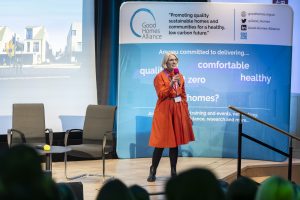
The day was launched with an impassioned talk by the journalist and writer Pete Apps. Pete has done so much to expose the deadly failings in accountability that led for example to the Grenfell tragedy. His book ‘Show me the Bodies’ eviscerated the processes and players that led to Grenfell, and his new book ‘Homesick’ takes apart the way housing policy has failed London and its residents.
Pete Apps defines bad building as building that gets in the way of people living the best lives they can. And in the end, it is always wasteful.“So much money is being spent on construction that doesn’t work. It baffles me.”
“We are seeing ventilation being missed, poor quality contractors, poor procurement .. much of this driven by commercial interests pressing on designs.”
He talked about a political culture where growth in numbers – be it gross national product, number of homes built – is pursued with very little heed for the quality and value of the outcomes. ”I’m mystified by the repeated insistence on cutting red tape” he said – after all, regulation is what determines at least some degree of quality and fairness.
Pete Apps had little time for approaches that ignore the lessons of the past and fail to make the building users the priority: “We don’t need exciting and new – it’s not that complicated to make homes that are right for people, but the effort has to go in to demanding the right outcomes.”

Flying blind
Both speakers and audience were all too painfully aware of the problems Peter Apps laid out. There was a tangible appetite for the construction ecosystem to change, to make quality buildings the norm. There was also plenty of agreement about how this might happen.
As we kept hearing, if quality and not just numbers are to be the goal then we need to restructure funding and procurement.
The first, indispensible step on this road is to build in the feedback loops that are so obviously missing. Clients and contractors alike can only deliver quality if they track results, to learn what works and what doesn’t – and step in quickly to remedy things if they aren’t right.
But as the Healthy Homes Hub’s Jenny Danson put it: “We’re not good at learning from our mistakes.”
“With a new car we now take it for granted that it will be fitted with sensors that warn us if something is amiss before the car goes seriously wrong. Cars used to break down frequently, its much rarer now. WE need to expect the same from our homes.”
Concerns were raised that the Future Homes Standard and the Warm Homes Plan might not herald these urgently needed changes.
Keeran Jugdoyal from MHCLG official attended to discuss progress on the Future Homes Standard (currently due this spring) and the Warm Homes Plan, which appeared shortly before the event. But he did not offer a concrete indication of how rigorously performance is expected to be tested under either.
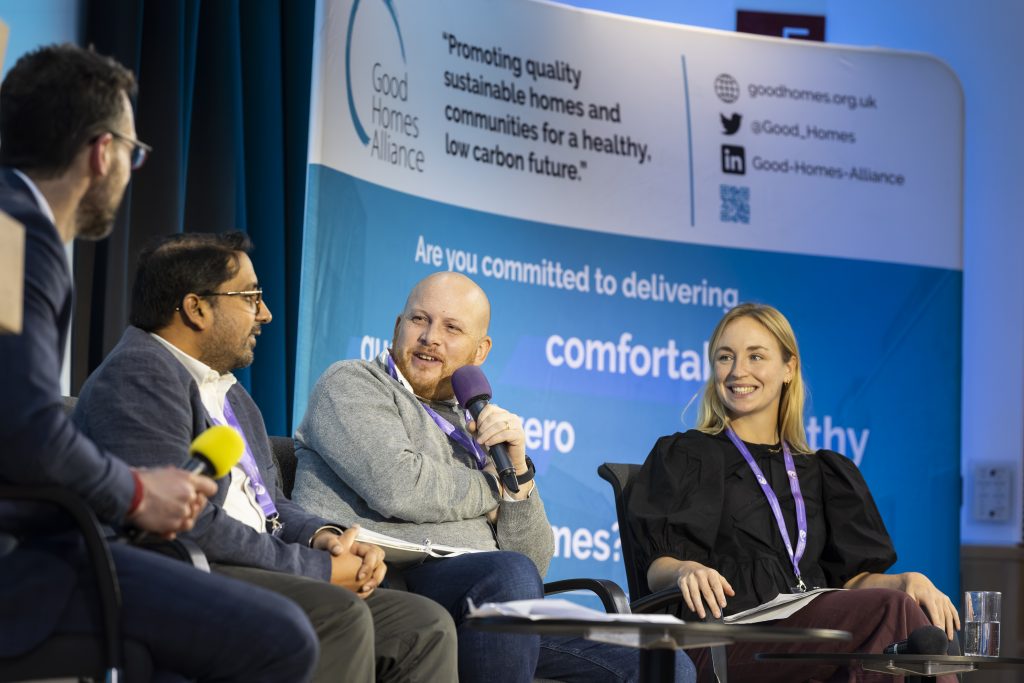
Defending the need to regulate for quality at all, he said that that setting standards such as the Future Home Standard was “addressing a market failure” because it communicated the value of new build homes to the house buyer. Standards were needed “so we can say to homebuyers this is a better home, it will have lower bills and better air quality.”
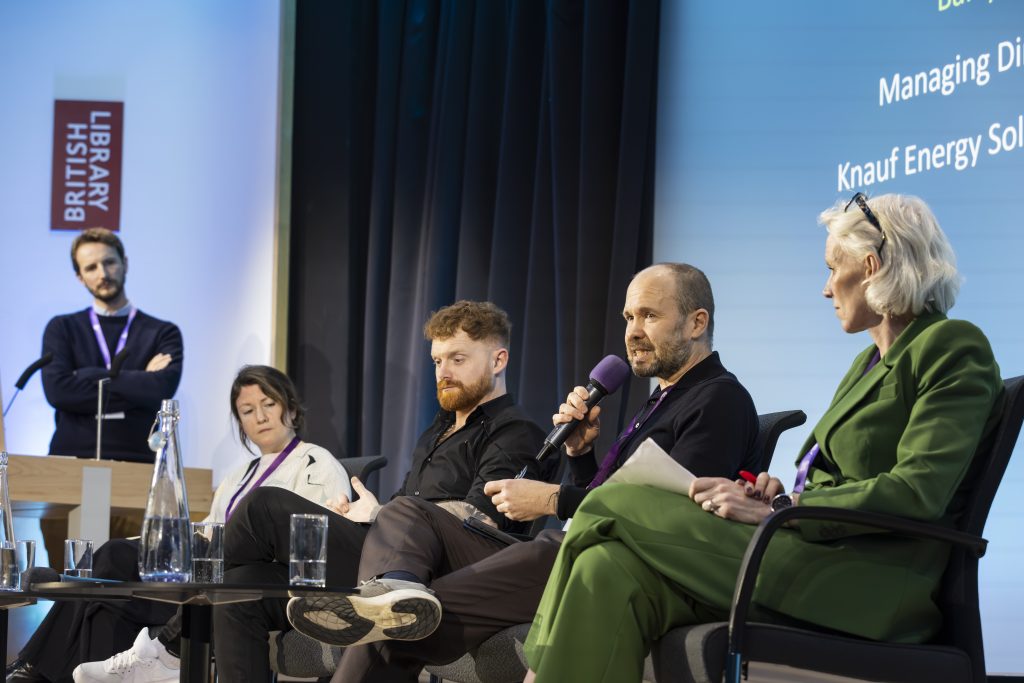
This perspective met a challenge from Barry Lynham from Knauf Energy Solutions. He pointed out that setting a design standard on its own does not necessarily deliver better buildings: “It’s a massive market failure to end up with a huge gap between intention and delivery. It the government is serious about addressing market failures, they need to put resource into tackling the performance gap.”
Barry has assessed the heat transfer coefficient of new build homes and has been horrified by some of the results. “We found wide variations in performance, even between supposedly identical dwellings – performance gaps in all directions, one or two were huge, down to really bad workmanship.”
“We are flying blind – to me it’s incredible.”
Vince House from Aereco ventilation echoed this; “We are not routinely measuring ventilation performance and air quality – but we should be.”
The ubiquity of sensing technology and of ‘smart’ analytics means it is far less expensive to do in homes than it used to be: as Barry Lynham’s colleague Stephen Heath pointed out, testing “would ensure residents are getting the home they paid for” – so he asked, why not make performance testing mandatory?
Right first time – procuring for quality
As it is possible to procure for specific performance results. Vince House said had been the case with an Energiesprong retrofit project he had supplied, for example. Barry Lynham echoed this: “There’s nothing to stop you put sensing or similar in your procurement rules.”
Some speakers were hopeful that change was creeping in. Raja Naveed from EEH contractors reported seeing more emphasis on quality in procurement, with more audits being required. However change is slow, and as David Smith from co-hosts the South East consortium indicated, not all clients were yet geared up to prioritise good results over simple numbers, especially in retrofit programmes.
Sensitive sensing
Despite the greatly improved availability of sensing devices and assessment technologies, delegates were reminded that not everyone is happy to have their homes ‘measured’ while they were living in them. One way to improve acceptability may be by integrating sensing into controls that help manage the indoor environment and bills.
The expectation was that use would increase – possibly via pressure from funders, Rasheed Turabi, Retrofit specialist at Phoenix Community Housing predicted.
Monitoring and feedback – especially when part of procurement – creates a virtuous circle that incentivises design and construction practices which teams are confident will deliver the goods. This is the approach that has been adopted in Scotland for procuring new schools: Performance of the buildings is monitored post completion, and funding is gradually released from the central budget, as the school passes its tests year on year.
The Passivhaus Trust has been pleased to note that many teams are opting to build with the support of the design, quality assurance and certification processes of Passivhaus, as the ability to “deliver as intended” with the Passivhaus standard is already well established.
We want PoE!
Assessing a project and learning from what went right and what went not so well extends well beyond the core regulated metrics such as ventilation flow rates and heat transfer coefficients.
Especially with multi-million pound developments, clients are increasingly looking to find out if they have been given the quality of development they were promised in terms of comfort and usabilty of homes, plus a range of issues relating to public realm and community.
Gwenaël Jerrett from the London Legacy Development Corporation described a comprehensive post-occupancy evaluation carried out or Chobham manor – one of the earlier developments in the Queen Elizabeth Olympic Park in London.
Alongside more technical measurements (energy use, temperature, humidity, noise and light), residents were asked about their experience of the homes – from comfort, both winter and summer, through to questions about how they felt about their home, and the wider neighbourhood.
Post Occupancy Evaluation like this is no trivial undertaking – and the response rate of around one third of residents to the initial questionnaire here was considered pretty good. “It does require commitment – which is why a level playing field with expectation that everyone would do this, would help,” Gwenael Jarrett added.
Gwenael Jarrett – along with a large proportion of the attendees, judging by the live polls – was keen to see POE becoming routine. “LLDC now build in POE at the procurement stage.”
POE like this is great for internal learning – but once you have gathered the data, will the developer and contractor want to see it shared? To see the Chobham Manor POE findings published is refreshing, but clients and contractors are often keener to do the evaluation, than to publish the results she said.
Some delegates did raise the issue that developers – and indeed landlords – might be reluctant to undertake evaluation, asking themselves ‘what if we find something bad? Will this cause trouble for us?’ Gwenael Jarrett countered this: “You have to be prepared to do the evaluation and demonstrate you care about outcomes. We are getting closer to a situation where the questions is ‘why aren’t you doing it?’”
Assessment like this is hard to standardise as includes subjective as well as objective metrics, but work is advancing to achieve exactly this. There is a move across the GLA to standardise POE approaches, for example. The Good Homes Alliance in partnership with the Building Performance Network is also working on this exact issue.
Giving with one hand, taking away with the other
While the Warm Homes Plan has a lot of focus on local action as a driver of appropriate retrofit and quality control, ironically the National Planning Policy Framework for England is set to drive in the opposite direction. The proposed NPPF aims to forbid local authorities from setting local standards that go beyond the base regulations.
Bioregional’s This proposal would go further than the 2023 ministerial statement to the same effect which has been successfully challenged more than once.
Bioregional is one of the leaders in this resistance, championing Local Authority construction requirements that enable them to meet their climate obligation, for example by mandating renewables or high fabric performance standards such as Passivhaus or equivalent ( see https://goodhomes.org.uk/net-zero-planning-policy for examples, collected by GHA in partnership with the Passivhaus Trust , Bioregional and others.)
“The government offers praise for ‘leadership and innovation’ while at the same time, stifling leadership from local authorities who want to champion high standards within their localities. The NPPF seeks to restrict any local requirements to go beyond regs – this is not innovation friendly!”

Carbon tunnel vision
We know that real-world energy performance too often falls short of intention – but at least there are statutory targets. With other critical dimensions such as indoor air quality or climate resilience, regulated targets are underdeveloped, or lacking altogether.
Ventilation specification, installation and performance is possibly the most glaring example.
Part F, according to Vince House, is not enough on its own to promise a healthy environment when, say, all the bed spaces in a dwelling are occupied. And there is no external check that what goes in actually meets those regulations anyway
“Ventilation is not subject to 3rd party validation – unlike other European countries. We are a long way down on here we need to be. We need accountability to get this right”
One delegate challenged what he called “carbon tunnel vision” – sidelining consideration of health, comfort and resilience in a one-dimensional pursuit of emissions reductions. He asked MHCLG’s Keeran Jugdoyal Keeran Jugdoyal if the government planned to embrace Home’s England’s Healthy Homes guidance (that points explicitly to the Passivhaus standard as a way to create healthy comfortable homes).
Keeran Jugdoyal acknowledged that health and comfort are part of the ‘broader picture’ of of good quality, and indicated that ventilation and overheating evidence were due to come under scrutiny at some point. But by his own admission the work behind the Future Homes Standard was “narrowly focused on part L”.
Current homes, future climate
It is not just health and wellbeing that is a minor player in the regulation and funding landscapes – pressing issues of climate resilience do not figure largely either.
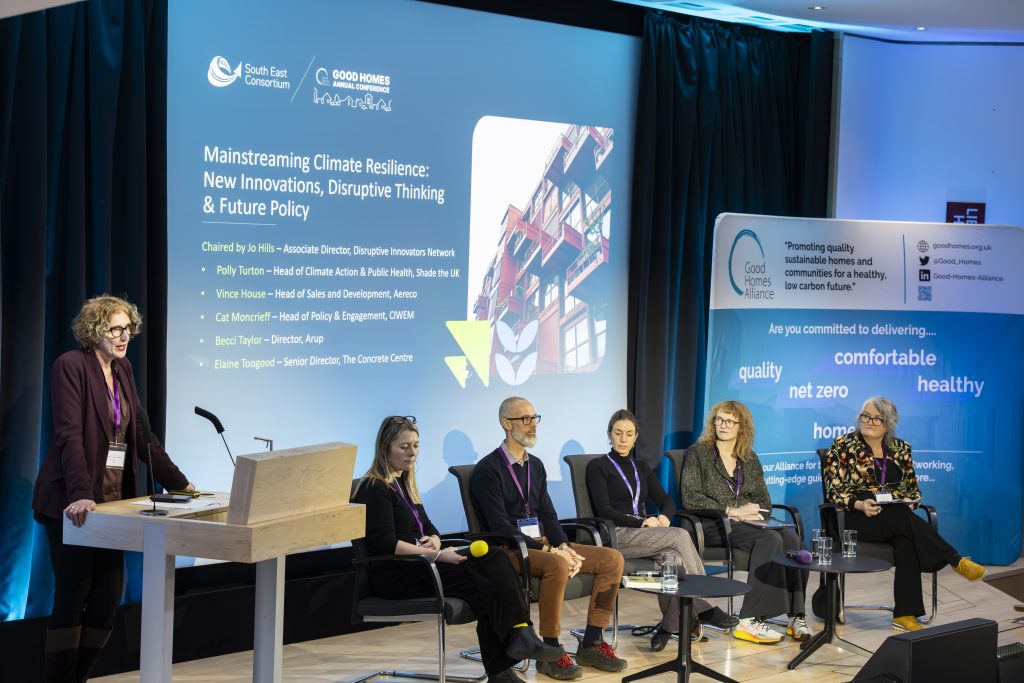
Becci Taylor of Arup shared modelling undertaken for the GLA identified overheating as the number one climate risk to London’s buildings. This echoing the national findings shared by by Kirsty Girvan of the UKGBC. Part O has only just come in, so remains unproven in use so far. But by numbers, most of the buildings in London at risk of overheating clearly already exist, and there is very little out there to assist their occupants. (The warm Homes Plan only suggests the Government will ‘seek to incorporate passive cooling measures within our capital funded schemes’ during the current Parliament.)
Climate vulnerability hurts asset value – but it is hard to protect our buildings when grant funding only covers measures that are geared at mitigation, Becci Taylor pointed out. Climate resilience needs to be embedded into retrofit design, including by introducing more green landscaping and of course shading: Polly Turton from Shade in the UK shared some examples that can be incorporated in both newbuild and retrofit.
Flooding is an even worse threat to individual asset value where there is a known risk. But as Cat Moncrieff of CIWEM (The Chartered Institution of Water and Environmental Management) explained, that risk is increasing hard to model, thanks to the increase in surface water flooding events – runoff from intense downpours that floods properties before it even reaches an established watercourse.
The Concrete Centre’s Elaine Toogood challenged designers to address flood resilience in materials choice, and to consider the embodied impact of stripping out and renewing components that had been irreparably damaged , versus masonry components that could be cleaned and retained.
Quality needs skills, skills need a reliable workstream
Rowley Maggs, Retrofit assessment and design contractors Ambue spoke passionately about the skills crisis that he feared could derail delivery of the Warm Homes Plan. “Who is going to be doing this delivery? It’s hard enough deliver what are doing already.” He questioned whether employers could believe in building long term capacity and engaging people, when “policy after policy change chops people off at the knees”. With the curtailment of ECO4 for example, he had seen whole teams let go already.
Yet it was continuity is central to building the skills and experience needed to close the performance gap: “But people just don’t have enough experience, the pool of people with the right skills and experience is very small.”
Raja Naveed from construction contractors EEH echoed Rowley Maggs’ points. “There have been huge peaks and troughs since 2019.” He did not exonerate employers entirely though: “The sector sees fabric work in particular as an entry level trade. That just isn’t the case, you need skills and knowledge. The way to secure this is to have a pipeline of work coming in, so people will invest in upskilling. Firms are having to reduce capacity and this doesn’t make for good stable working conditions.”
Raja Naveed wasn’t completely despondent, and reported that some clients trying to move away from just the cheapest: “We are seeing more emphasis on quality in procurement . We do need to be more thorough now – audits are required during programme etc. So its important to us to retain skilled people so we can meet these demands.
Rasheed Turabi pointed out that if things don’t change, one big casualty from short-burst funding arrangements, was delivery of the programme itself. “The stop-start workflows are really unhelpful. SHDF Wave 2 was underspent – timelines were so short – we were not able to design schemes quickly enough to meet them.”
Good homes need good fabric, not just tech
There was concern that while there was understandable nervousness around external wall insulation following the dismaying Ofgem audit of solid wall insulation installed under ECO4, the answer was not simply to stop doing it.
Ben from United Infrastructure reported finding that landlords were now tending to avoid solid wall insulation – they ‘want to take time to do it right ‘ but the time , skills and funding are just not there. But simply rowing back from the technology in programming and funding was not the answer delegates believed. It was excluding residents of some of the coldest homes from help to improve their loving conditions, and would also hinder the replacement of fossil fuel systems.
As Rasheed Turabi Phoenix Community Housing Pointed out, landlords are very reluctant to install low carbon heating in solid wall homes unless there have been fabric improvements, because of the risk of driving residents into, or further into, fuel poverty.
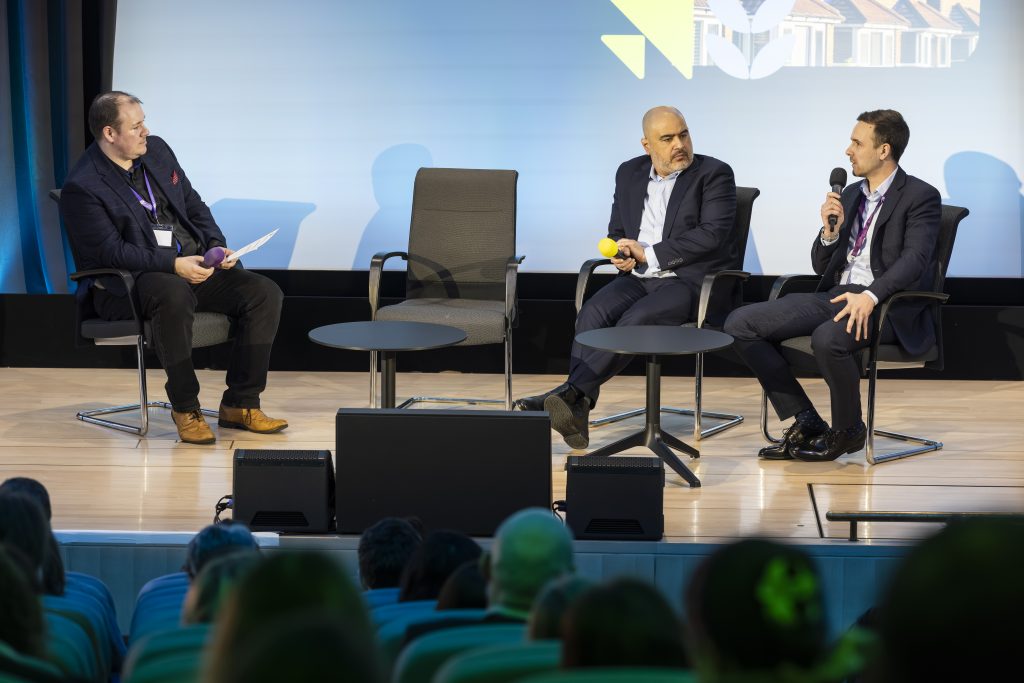
He made the case that retrofitting hard to treat dwellings should be funded separately, on ground that otherwise the ‘budget take’ was disproportionate versus say standard cavity wall homes that can be decarbonised for 1/3 as much capital expenditure. “We hope that in following SHF waves there will be more provision, and that we will be able to be more confident to design schemes.”
As with retrofit, in newbuild the current government focus is not first and foremost on fabric. Keeran Jugdoyal explained that the fabric ambitions in Future Homes Standard would be largely unchanged from those in Part L 2021. He did note that they “could have simply adopted Passivhaus” however went on to say that “developers said ‘well have to rethink supply chain’”. He added: “I think we do need to challenge that.”
While Keeran Jugdoyal did not expand on the developer objections, it’s worth noting that Passivhaus is not just about components such as MVHR and triple glazing (which after all are no longer unheard of in non-Passivhaus new build)
From Pete Apps’s opening presentation onward, the day reminded us of many familiar issues in housing construction – the mould and damp crisis, failing insulation, the struggle to ‘sell’ decarbonisation because bills are not falling when low carbon heating is installed, the poor build quality of developments where the same mistakes such as overheating are repeated again and again.
All these come back to the same core issues: the lack of a feedback loop, the stop-start nature of construction pipelines, and the wider industry ecosystem that privileges a race-to-the-bottom numbers game, rather than designing in incentives for quality.
Yet is was so clear from this event that there is a genuine hunger to build well, to be asked, and paid, to do so, and on an ongoing basis that would support the culture change so urgently required.
No-one goes to work wanting to do a bad job. When people are commissioned to produce a building that really performs well, the reward is increased job satisfaction right across the team – alongside genuine asset value. These are buildings that enable people to meet Pete Apps’ aspiration: buildings where people can create a good home , free from all the damage, danger and demoralisation that substandard construction brings.
Call to action!
Are you seeking to go beyond business as usual and collaborate to deliver homes fit for the 21st century? Join the Good Homes Alliance! If you’d like any further information, or to have a chat with one of our friendly team, you can contact us here.
Gallery